
Anúncios
# The Holy Quran: Embracing the Sacred Book Through Reading and Learning
The Quran stands as Islam’s most sacred text, offering divine guidance, spiritual wisdom, and transformative teachings for over 1.4 billion Muslims worldwide.
Anúncios
For centuries, believers have turned to this divine revelation seeking answers, comfort, and direction in their daily lives. The relationship between a Muslim and the Quran transcends mere reading—it becomes a lifelong journey of understanding, reflection, and spiritual growth.
Whether you’re discovering the Quran for the first time or deepening your existing connection, understanding its importance and approaching it with the right mindset can profoundly transform your spiritual experience. Let’s explore the magnificent dimensions of this sacred book and discover how its timeless wisdom continues to illuminate hearts across generations. ✨
Anúncios
📖 Understanding the Divine Origin of the Quran
The Quran represents the literal word of Allah (God), revealed to Prophet Muhammad ﷺ through the Angel Jibreel (Gabriel) over a period of 23 years. This revelation began in 610 CE in the cave of Hira, near Mecca, when the Prophet received the first verses of Surah Al-Alaq.
Unlike other religious texts, the Quran has remained unchanged since its revelation—every word, letter, and diacritical mark preserved in its original Arabic form. This miraculous preservation fulfills the divine promise stated within the Quran itself: “Indeed, it is We who sent down the Quran and indeed, We will be its guardian” (15:9).
The Quran contains 114 chapters (Surahs) and approximately 6,236 verses (Ayahs), each carrying profound meanings and guidance. From the shortest chapter containing just three verses to the longest spanning 286 verses, every Surah serves a unique purpose in the comprehensive message delivered to humanity.


🌟 Why Reading the Quran Matters in Daily Life
Engaging with the Quran regularly brings countless spiritual, psychological, and practical benefits to believers. The act of reading itself becomes an act of worship (ibadah), with rewards multiplying for every letter recited.
Prophet Muhammad ﷺ said: “Whoever reads a letter from the Book of Allah, he will have a reward, and this reward will be multiplied by ten” (Tirmidhi). This hadith emphasizes that even basic interaction with the sacred text brings divine blessings into one’s life.
Beyond spiritual rewards, Quranic reading provides tangible benefits for mental health and emotional well-being. The rhythmic recitation calms anxiety, the profound messages offer perspective during hardship, and the divine promises bring hope during despair. Many Muslims describe feeling an inexplicable peace wash over them during Quranic recitation—a phenomenon supported by studies showing reduced stress levels during spiritual practices.
Spiritual Nourishment Through Divine Words
Just as the body requires physical nourishment, the soul needs spiritual sustenance. The Quran serves as the ultimate spiritual food, addressing the deepest human needs for purpose, meaning, and connection with the Divine.
When you read the Quran with reflection (tadabbur), you’re not simply processing words on a page. You’re engaging in a conversation with your Creator, receiving personalized guidance that speaks directly to your circumstances, challenges, and aspirations.
💎 Essential Lessons and Teachings Within the Sacred Text
The Quran encompasses comprehensive guidance covering every aspect of human existence. Its teachings address theology, morality, law, history, science, and spirituality—creating a holistic framework for living a meaningful life.
Monotheism (Tawhid): The Foundation of Faith
The central message running through every page of the Quran is the absolute oneness of Allah. This concept—known as Tawhid—forms the bedrock of Islamic belief and shapes how Muslims understand their relationship with God, creation, and each other.
The Quran repeatedly emphasizes that Allah alone deserves worship, has no partners or equals, and possesses all perfect attributes. Surah Al-Ikhlas (112:1-4) encapsulates this beautifully: “Say, He is Allah, [who is] One, Allah, the Eternal Refuge. He neither begets nor is born, nor is there to Him any equivalent.”
Moral and Ethical Excellence
The Quran provides detailed guidance on character development and ethical behavior. It promotes honesty, justice, compassion, humility, patience, and gratitude while condemning arrogance, dishonesty, oppression, and cruelty.
These teachings aren’t presented as abstract ideals but as practical principles applicable to real-life situations. The Quran addresses how to conduct business transactions fairly, treat family members with kindness, resolve conflicts peacefully, and contribute positively to society.
Stories of Prophets: Lessons Through Narrative
The Quran contains inspiring accounts of prophets and messengers sent to different nations throughout history. These stories aren’t merely historical records—they’re rich with lessons applicable to contemporary life.
From Prophet Ibrahim’s unwavering faith to Prophet Yusuf’s patience during adversity, from Prophet Musa’s courage against tyranny to Prophet Isa’s miraculous birth—each narrative offers unique insights into human nature, divine wisdom, and the consequences of choices.
🕌 Developing a Meaningful Relationship With the Quran
Creating a sustainable, enriching connection with the Quran requires intentionality, consistency, and the right approach. Many people struggle not from lack of desire but from unclear strategies for engagement.
Starting With Small, Consistent Steps
Rather than overwhelming yourself with ambitious goals, begin with achievable targets. Reading just one page daily, or even a few verses, establishes a habit that can gradually expand. The Prophet ﷺ advised: “The most beloved deed to Allah is the most regular and constant, even if it were little” (Bukhari).
Set a specific time each day for Quranic reading—perhaps after Fajr prayer, during lunch break, or before sleep. Consistency matters more than quantity. A sustainable practice of five minutes daily surpasses sporadic hour-long sessions in building lasting connection.
Understanding Through Translation and Tafsir
While reciting in Arabic carries immense blessings, understanding the meanings transforms the experience from mechanical reading to heartfelt engagement. Utilize reliable translations in your native language alongside the Arabic text.
Tafsir (Quranic exegesis) provides deeper context, explaining historical circumstances of revelation (asbab al-nuzul), linguistic nuances, and scholarly interpretations. Resources like Tafsir Ibn Kathir, Tafsir Al-Jalalayn, and contemporary works make these insights accessible to general readers.
Memorization (Hifz): Carrying the Quran in Your Heart
Memorizing Quranic verses—whether a few ayahs or the entire Quran—creates a permanent spiritual treasure within your heart. Prophet Muhammad ﷺ said: “The one who was devoted to the Quran will be told on the Day of Resurrection: ‘Recite and ascend (in ranks) as you used to recitate when you were in the world'” (Abu Dawud).
Begin with shorter Surahs commonly recited in prayer, then gradually progress to longer passages. Repetition, writing, listening to recitations, and reviewing regularly all aid the memorization process. Modern apps and online programs provide structured frameworks for hifz journeys.
🌍 The Quran’s Universal Message for All Humanity
While revealed through an Arabic prophet in 7th-century Arabia, the Quran explicitly addresses all of humanity. Its opening chapter, Al-Fatihah, is recited billions of times daily by Muslims worldwide, transcending cultural, linguistic, and geographical boundaries.
The Quran describes itself as “a guidance for mankind” (2:185) and “a reminder to the worlds” (81:27). Its principles of justice, compassion, dignity, and purpose resonate with universal human values while providing specific guidance for those who submit to Allah.
Addressing Contemporary Challenges
Despite being revealed over 1,400 years ago, the Quran speaks powerfully to modern challenges. Its teachings on environmental stewardship, social justice, economic equity, family relationships, and spiritual wellness offer solutions to pressing contemporary issues.
The Quran encourages critical thinking, seeking knowledge, and reflecting upon creation—values essential in our information-saturated age. It warns against extremism while promoting balanced moderation (wasatiyyah), a message particularly relevant in today’s polarized world.
🎯 Practical Tips for Deepening Quranic Engagement
Transforming Quranic reading from routine obligation into meaningful spiritual practice requires practical strategies that fit your lifestyle and learning preferences.
Create a Sacred Reading Space
Designate a clean, quiet area specifically for Quranic reading. This physical space signals to your mind that you’re entering a time of spiritual focus. Ensure you’re in a state of ritual purity (wudu), sit respectfully, and eliminate distractions like phones or background noise.
Engage Multiple Senses
Listening to beautiful Quranic recitations by skilled reciters (qaris) like Sheikh Mishary Rashid, Sheikh Abdul Rahman Al-Sudais, or Sheikh Saad Al-Ghamdi enhances emotional connection. The melodious recitation, governed by tajweed rules, touches hearts in ways silent reading cannot.
Follow along with the written text while listening, or recite aloud yourself. Many find that vocalizing verses aids both memorization and spiritual absorption.
Reflect and Journal
Keep a Quran journal where you record verses that resonate with you, reflections on their meanings, and how they apply to your life circumstances. This practice personalizes your Quranic journey and creates a valuable spiritual record you can revisit.
Ask yourself questions while reading: What is Allah teaching me through this verse? How can I implement this guidance today? What changes should I make in my character or behavior?
Join Study Circles and Communities
Learning alongside others accelerates understanding and maintains motivation. Join local mosque study circles, online Quran classes, or discussion groups where you can share insights, ask questions, and benefit from diverse perspectives.
Teaching others what you’ve learned reinforces your own knowledge and earns additional rewards. The Prophet ﷺ said: “The best among you are those who learn the Quran and teach it” (Bukhari).
📱 Leveraging Technology for Quranic Learning
Modern technology has made accessing the Quran easier than ever before. Numerous apps, websites, and digital resources support various aspects of Quranic engagement—from basic reading to advanced study.
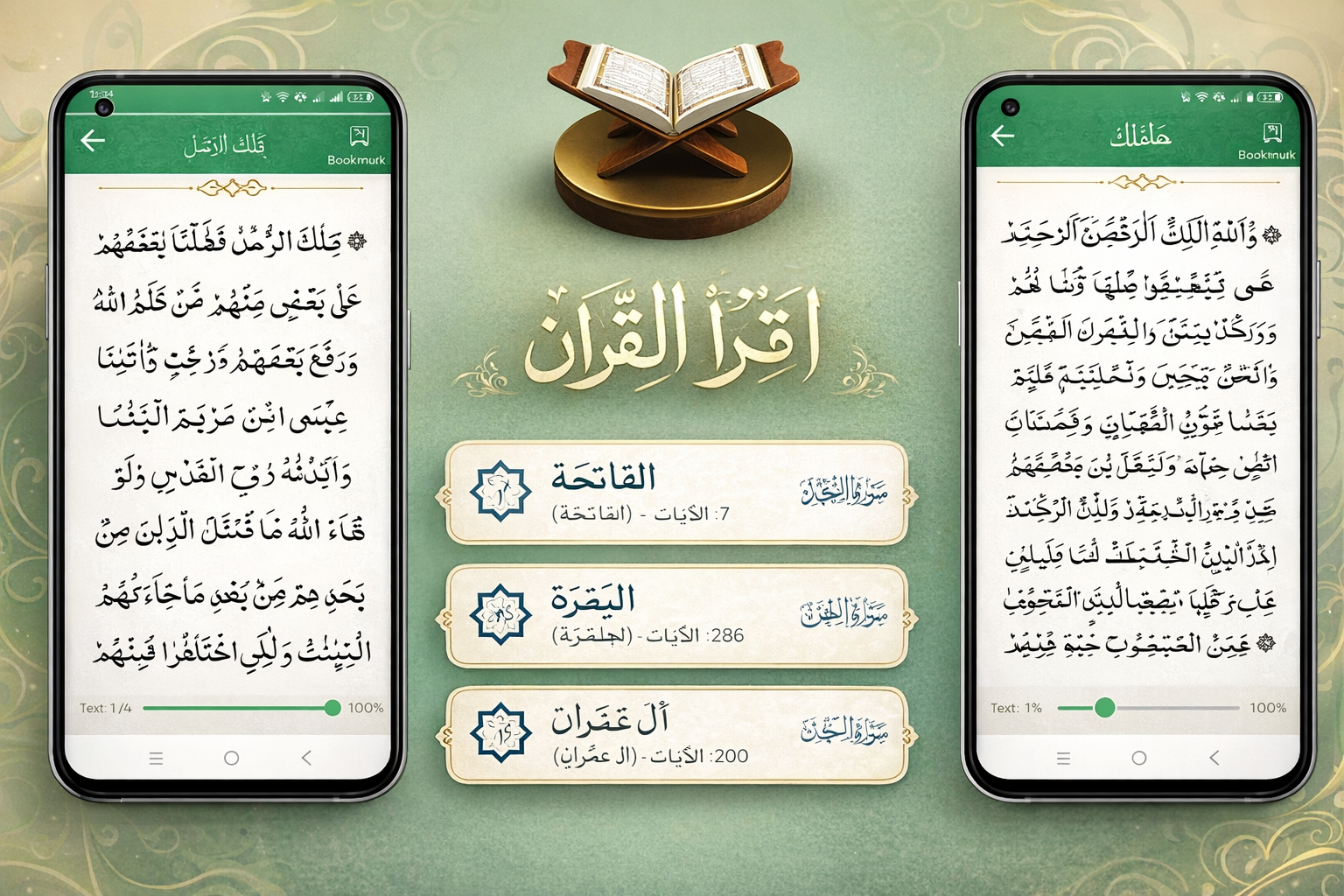
Quality Quran apps offer features like multiple translations, audio recitations by various qaris, tajweed guidance, bookmarking, search functions, and progress tracking. These tools allow you to carry the Quran everywhere, turning waiting time or commutes into opportunities for spiritual growth.
Online platforms provide structured courses in Quranic Arabic, tafsir, and memorization with certified instructors. Video lectures, podcasts, and social media channels dedicated to Quranic content make learning accessible regardless of location or schedule.
🌙 The Blessing of Quranic Recitation in Prayer
The Quran and Islamic prayer (salah) share an inseparable connection. Every Muslim recites Quranic verses during their five daily prayers, with Surah Al-Fatihah being an obligatory component of each unit (rakah).
Prophet Muhammad ﷺ stated: “There is no prayer for the one who does not recite the opening chapter of the Book” (Bukhari). This integration ensures that even Muslims who struggle with consistent Quran reading outside prayer maintain daily connection with the sacred text.
Learning additional Surahs and longer passages enriches your prayer experience, preventing monotony and deepening concentration (khushu’). The variety also allows you to select verses appropriate to different circumstances—seeking guidance, expressing gratitude, or finding comfort.

🕊️ Healing and Comfort Through Divine Words
The Quran serves as spiritual healing (shifa) for believers experiencing physical illness, emotional distress, or spiritual struggles. Allah declares: “And We send down of the Quran that which is healing and mercy for the believers” (17:82).
Certain verses and Surahs are particularly recommended for protection and healing. Ayat al-Kursi (2:255), the last two verses of Surah Al-Baqarah, and the three Quls (Surahs 112, 113, 114) are frequently recited for spiritual protection and peace.
Many Muslims report profound comfort during difficult times through Quranic recitation and reflection. The divine promises, reminders of Allah’s mercy, and stories of prophets overcoming hardships provide perspective and strength when facing personal trials.
🎓 Teaching Children the Love of Quran
Instilling Quranic love in children creates lifelong spiritual foundations. The early years offer optimal neuroplasticity for memorization, making childhood an ideal time for hifz while forming positive associations with the sacred text.
Make Quranic learning enjoyable through age-appropriate methods: colorful books for young children, interactive apps with games and rewards for elementary ages, and meaningful discussions about Quranic stories and lessons for teenagers.
Lead by example—children who see parents regularly reading, reciting, and discussing the Quran naturally develop similar habits. Create family Quran time where everyone reads together, shares reflections, or listens to recitations.
💫 The Quran’s Miraculous Nature (I’jaz)
Muslims believe the Quran itself constitutes a miracle—its linguistic excellence, scientific insights, historical accuracy, preserved authenticity, and transformative power serving as evidence of divine origin.
The Quran challenged the eloquent Arabs of the 7th century to produce even a single chapter comparable to it—a challenge that remains unmet after fourteen centuries. Its literary beauty, rhetorical sophistication, and phonetic harmony continue captivating scholars and listeners alike.
Modern discoveries in embryology, cosmology, oceanography, and other sciences have led some to observe remarkable correspondences with Quranic verses revealed centuries before such knowledge became scientifically established. While the Quran is primarily a book of guidance rather than science, these observations strengthen faith for many believers.
🌟 Transforming Knowledge Into Action
The ultimate purpose of Quranic engagement extends beyond intellectual knowledge to practical implementation. The Companions of the Prophet would learn ten verses at a time and wouldn’t proceed to the next until they had understood and applied those verses in their lives.
Identify one teaching from your Quranic reading each week and consciously work to implement it. Perhaps it’s speaking more truthfully, controlling anger better, giving charity regularly, or treating parents with greater kindness. This approach transforms the Quran from a book you read into a guide you live by.
Allah reminds us: “This is a blessed Book which We have revealed to you, [O Muhammad], that they might reflect upon its verses and that those of understanding would be reminded” (38:29). Reflection (tadabbur) naturally leads to action when hearts are receptive and intentions sincere.
🙏 Making Dua for Understanding and Guidance
Approaching the Quran with humility and seeking Allah’s help in understanding represents an essential component of meaningful engagement. The Quran’s depths can only be truly accessed through divine assistance.
Regularly make dua asking Allah to grant you comprehension of His Book, ability to memorize and implement its teachings, and steadfastness in maintaining your connection. Prophet Muhammad ﷺ would pray: “O Allah, I seek refuge in You from knowledge that does not benefit” (Muslim)—reminding us that Quranic knowledge should transform hearts and actions.
The Quran itself teaches us to pray: “Our Lord, let not our hearts deviate after You have guided us and grant us from Yourself mercy. Indeed, You are the Bestower” (3:8). This acknowledges our dependence on Allah for maintaining guidance once received.
✨ Your Journey With the Sacred Book
Every person’s Quranic journey is unique—shaped by individual circumstances, challenges, and spiritual states. Whether you’re taking your first steps or have walked this path for decades, opportunities for deeper connection always exist.
The Quran remains eternally relevant, offering fresh insights with each reading. Verses you’ve recited hundreds of times suddenly speak to new situations, questions find unexpected answers, and comfort arrives precisely when needed. This dynamic, living quality distinguishes the Quran as truly divine guidance.
Embrace your current stage without comparison to others. The mother managing young children who reads five minutes daily stands equally valued before Allah as the student memorizing pages. Sincerity and consistency matter more than quantity or speed.
Most importantly, remember that the Quran is Allah’s direct communication with you—personal, loving, and infinitely merciful. Open it with this awareness, and you’ll discover that these aren’t merely historical words but timeless guidance addressing your exact needs today. 💚
May Allah grant us all increased love for His Book, deeper understanding of its meanings, and success in implementing its guidance in every aspect of our lives. Ameen.
